Trusted contentTrusted content

AI-generated insights from the world’s most trusted scientific content including Scopus data and Elsevier’s publisher-neutral database.

Identify fundersIdentify funders

Find potential funders from within the research community, even providing guidance on what funders typically look for.


Seamless AI workspaceSeamless AI workspace

Generate ideas, plan projects, explore literature, find collaborators, and identify funding - all in one secure environment. 
 

Deep research Deep research

Build detailed reports, highlighting emerging patterns, contradictions, and evidence gaps that traditional searches often miss. 

Academics and students: 
Choose the right plan for you

ScienceDirect AI 
From question to evidence in seconds

Subscribe today to instantly find, cite, compare and explore
trusted evidence from deep within peer-reviewed literature.

ScienceDirect AI 
From question to evidence in seconds

Subscribe today to instantly find, cite, compare and explore
trusted evidence from deep within peer-reviewed literature.

Academics and students: 
Choose the right plan for you

  • LeapSpace

    7 day free trial*

    • LeapSpace Search
    • Funding Scout
    • Author Search
    • Reading Assistant
    • Deep Research
    €0 / 1 week

    A paid subscription will begin after your free trial. We will notify you beforehand.

  • LeapSpace

    Premium*

    • LeapSpace Search
    • Funding Scout
    • Author Search
    • Reading Assistant
    • Deep Research
    €290 / year

    Billed annually, cancel anytime.

*These subscriptions are not for corporate use and do not include reading access to additional journal articles or books.
Considering LeapSpace for multiple users at your organization? Get in touch

What’s included in your subscription

Advanced literature search

Speed up in-depth literature reviews, synthesizing peer-reviewed trusted research, highlighting methodologies and surfacing new insights.

  • Advance complex research queries and interdisciplinary topics
  • Ask follow-up questions to elaborate, refocus or explore new perspectives
  • Revisit previous queries to build on past insights
Advanced literature search
Watch now 0:30 minutes
Find funding and collaborators
Watch now 0:30 minutes

Find funding and collaborators

Uncover thousands of local and international funding opportunities and identity potential collaborators by surfacing individual profiles, experience, and expertise.

  • Review funding related to specific research topics, drilling down to specific funding opportunities
  • Formulate a list of people working on a research topic, exploring an individual’s previous research to find the right collaborator

Trust Cards

Strengthen confidence when making informed research decisions with Trust Card signals: Link to Statement shows how a claim alignd with its cited source while Claim Radar shows how it holds up across the broader research landscape.

  • Evaluate the reliability of a response to your question
  • Reduce the time spent locating sources and fact-checking
  • Show the exact passage used to support a claim
  • Surface sources that support, contradict, or return a mixed finding at the claim level
Trust Cards
Watch now 0:35 minutes
Deep research
Watch now 0:30 minutes

Deep research

Develop greater confidence in research planning with Deep Research. Designed to enhance critical thinking, assist in solving complex problems and spark further exploration, it thinks with you, not for you.

  • Delivers detailed reports, highlights emerging patterns, contradictions, and evidence gaps that traditional searches often miss
  • Conducts extensive searches across the curated literature in LeapSpace, and refines its approach as new insights emerge
  • Generates and displays the steps it takes when creating a report

Reading Assistant

Determine relevancy or identify key takeaways using the Reading Assistant. Sorting through the literature has never been easier. Available on specific articles, book chapters, and PDFs in ScienceDirect and Mendeley.

  • Chat with and interrogate the article or book chapter to summarize sections or pinpoint insights
  • Ask follow-up questions and receive suggested research questions
  • Resume past research sessions with saved queries and responses

Compare

Identify gaps, assess limitations and evaluate past experiments with Compare. Use literature from the query response to pull into a table for analysis.

  • Extracts goals, materials, methods, results, and conclusions
  • Includes all experiments from an article in the table
  • Exports the table into a CSV for future use

File Upload

Upload your own papers, notes, or reports and ask questions that connect your content with the wider research landscape.

  • Upload up to five PDF files per conversation
  • Your files are encrypted and never used to train LeapSpace models or shared with other users
  • Combine your work with 100M+ Scopus-indexed peer-reviewed sources in a single conversation
  • Test a draft paper against recent literature and find gaps your research has not addressed

The LeapSpace difference

Built on peer-reviewed research

LeapSpace draws only from trusted scientific content, unlike general AI tools that typically rely on unverified web data.

Only verified scientific sources

  • LeapSpace offers researchers the largest (and still growing) collection of research abstracts and millions of peer-reviewed full-text articles and books from Elsevier and other leading scientific publishers and societies.
  • An independent expert advisory board will oversee LeapSpace’s transparency to ensure its algorithms remain publisher-neutral and explainable. 

Trust and transparency, every time

84% of researchers use AI, but only 22% trust it (Elsevier, Researcher of the Future report). LeapSpace is designed to bridge that gap.

Verified answers, transparent process

  • Every AI-generated insight is referenced and has its own "Trust Card," a foundational capability which provides context and transparency into every result, supporting critical thinking and helping researchers calibrate the strength of the evidence.
  • Content is curated by multiple tiers of human experts, including journal peer reviewers, the independent Scopus Content Selection and Advisory Board , and a new independent AI Advisory Board.
  • LeapSpace shows you how it works in real time, sharing the steps it takes on-screen.

Commitment to security and privacy

Built with enterprise-grade security and a responsible AI approach, LeapSpace safeguards every user.

Only verified scientific sources

  • Leapspace offers researchers the largest (and still growing) collection of research abstracts and millions of peer-reviewed full-text articles and books from Elsevier and other leading scientific publishers and societies. 
  • An independent expert advisory board will oversee LeapSpace’s transparency to ensure its algorithms remain publisher-neutral and explainable. 

Frequently asked questions

What content does LeapSpace use?

LeapSpace draws on trusted, publisher‑neutral scholarly sources, including:

  • Peer‑reviewed abstracts and metadata indexed in Scopus
  • Selected full‑text journal articles and book chapters from subscription and open‑access sources
  • Funding opportunity data from Elsevier’s funding databases

Content coverage continues to expand as new sources are added. Users can also upload their own documents to support analysis.

How current is the content in LeapSpace?

LeapSpace uses a knowledge base that is updated on a daily basis. Newly published or newly indexed research is regularly added so that responses are informed by the latest relevant material available at the time of your query.

Because content and indexing change over time, responses may vary as new publications become available or existing records are updated. LeapSpace responses are not intended to be cited; users should always consult and cite the original source documents referenced in the response.

How does LeapSpace handle data privacy and security?

LeapSpace processes user data in line with Elsevier’s Privacy Policy and Responsible AI principles, and in accordance with applicable privacy laws, including GDPR. 

User interactions are protected using industry‑standard security measures. Elsevier does not use individual user prompts to train public AI models and reviews data only in aggregated, anonymized form to improve system performance. 

Learn more: https://www-elsevier-com.ucc.idm.oclc.org/about/responsible-ai/ai-use-faq

Can I use LeapSpace if I don’t have access to journal articles and books through my institution?

Yes, you can use LeapSpace features regardless of your institution’s content access. However, the Reading Assistant tool is only available on documents you are entitled to access. If you can view the article or book chapter on ScienceDirect without a paywall, you can use the Reading Assistant on that document.

Ready to get started with LeapSpace?

Move from curiosity to discovery faster

Unlock smarter research insights, faster

Use your own words

Ask complex questions your way and instantly find what you need from ScienceDirect AI’s underlying body of peer-reviewed, full-text articles and book chapters.  

  • Explain what you need, in any language.  

  • Get responses from deep within full-text documents, decide what to read next. 

  • Uncover insights easy to miss by generalist AI tools. 

ScienceDirect AI
Goodbye wasted research time. Hello relevance
Watch now 0:50 minutes

Take the effort out of comparing experiments

So much science, so little time! Let’s give you a helping hand.

  • Extract methods, results and more across experiments within a selection of articles. 

  • See instantly not just what was found but how the authors found it. 

  • View summarized information in a table that is easy to export. 

ScienceDirect AI
Goodbye wasted research time. Hello relevance
Watch now 0:50 minutes

Dig deeper, read smarter 

Summarize and ask questions about a document using the Reading Assistant.  

  • Get a sense of whether a document has insights that are relevant for you.  
  • Select pre-generated questions, write your own and ask follow-up questions to dig deeper. 
  • Use the Reading Assistant on saved PDFs in your Mendeley library.
ScienceDirect AI
Goodbye wasted research time. Hello relevance
Watch now 0:50 minutes

Take transparency to a new level

In the quest for trust, origin is everything. Be confident that insights you gain come from trusted content.

  • Access citations with direct links to the original source material. 

  • Instantly view the source passage so you can verify AI-generated claims. 

  • Get summarized insights from trusted, peer-reviewed, full-text articles and book chapters.

ScienceDirect AI
Goodbye wasted research time. Hello relevance
Watch now 0:50 minutes

Free access to Mendeley’s AI features

Mendeley helps researchers organize, read and share scientific papers in a personalized library. Use AI features within your own library:

  • Reading Assistant: Summarize, clarify or explore findings from documents saved to your library.
  • Compare Experiments: Analyze multiple studies in your library side-by-side across results and methods.
  • Coming soon - Ask My Library: Use AI to search, summarize and compare PDFs in your Mendeley library.

* Only available in Mendeley Reference Manager

What researchers say about ScienceDirect AI

“ScienceDirect AI has transformed the way I work. Amidst AI tools that hallucinate or provide false information, this tool stands out for its precision.”

Professor

Portugal

“When it comes to research, integrated AI tools are the way of the future instead of third party tools (like ChatGPT).”

Librarian

UAE

“Quickly generating precise summaries and extract key findings from research papers saved me significant time and effort.”

Faculty Member

Hong Kong

“Excellent in summarizing articles and highlighting key points, making research more efficient.”

ScienceDirect AI user

South Africa

“Very helpful in synthesizing large evidence for literature reviews.”

ScienceDirect AI user

Ghana

“These tools have significantly enhanced my research by streamlining literature reviews and providing insightful summaries, which saves time and improves understanding of complex topics.”

Faculty Member

Hong Kong

“I like that the answers are reliable and based on actual research papers, which makes me feel more confident to use it instead of ChatGPT for answering research related questions.”

Postdoctoral Researcher

Netherlands

“I love the comparison table of the articles. Excellent all-around tool!”

Faculty Member

Trinidad and Tobago

“ScienceDirect AI cites articles more accurately than other tools.”

Faculty Member

Trinidad and Tobago

Surface the knowledge you need, in less time

Save valuable research time. 5 hours per week: average time saved per week by researchers with the help of ScienceDirect AI Save valuable research time. 5 hours per week: average time saved per week by researchers with the help of ScienceDirect AI
Rely on trusted content. 29% of citations worldwide: nearly 3 in 10 citations lead to Elsevier journals, reflecting our commitment to quality content. Rely on trusted content. 29% of citations worldwide: nearly 3 in 10 citations lead to Elsevier journals, reflecting our commitment to quality content.
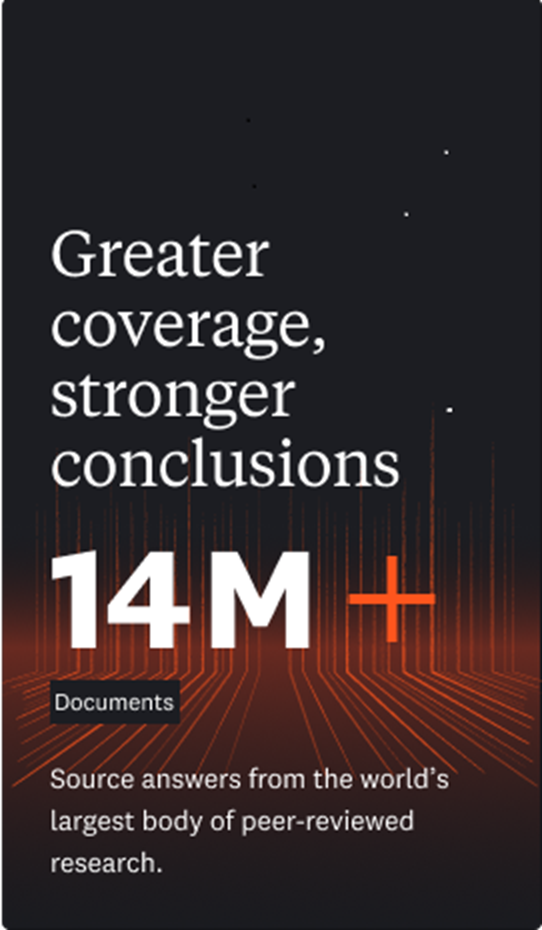
Greater coverage, stronger conclusions. Over 14 million documents: source answers from the world’s largest body of peer-reviewed research.Greater coverage, stronger conclusions. Over 14 million documents: source answers from the world’s largest body of peer-reviewed research.
Refined by researchers like you. Built and tested in collaboration with the research community (over 30,000 researchers), with continuous refinements.Refined by researchers like you. Built and tested in collaboration with the research community (over 30,000 researchers), with continuous refinements.

Frequently asked questions

Does a subscription to ScienceDirect AI include access to full-text journal articles and books?

No, a ScienceDirect AI subscription does not include automatic access to journal articles or books. Access to underlying content depends on your institution’s existing ScienceDirect subscriptions or any individual content purchases you make.

Some ScienceDirect AI features such as ‘Ask ScienceDirect AI’ and ‘Compare Experiments’ generate responses and summaries from the entire ScienceDirect AI index, regardless of your entitlement. This means you may receive information from content you don’t have access to. However, the Reading Assistant tool is only available on documents you are entitled to access. If you can view the full text on ScienceDirect without a paywall, you can use the Reading Assistant on that document. 

Can I use ScienceDirect AI if I don’t have access to journal articles and books through my institution?

Yes, you can use ScienceDirect AI’s features regardless of your institution’s content access. However, the Reading Assistant tool is only available on documents you are entitled to access. If you can view the article or book chapter on ScienceDirect without a paywall, you can use the Reading Assistant on that document.

How does ScienceDirect AI ensure data privacy and security? 

As we embed GenAI features in ScienceDirect and other products, we do so in line with Elsevier’s Responsible AI Principles and Privacy Policy.

Do my interactions with ScienceDirect AI get used to train Large Language Models (LLMs)?

We have agreements in place with the third-party large language models we use to ensure that no information is stored or used to train their public models.

We also comply with Elsevier Data Privacy Principles and global privacy regulations such as the GDPR. 

What technology does ScienceDirect AI use? 

ScienceDirect employs vector search for retrieval of relevant insights from the ScienceDirect AI corpus to analyze, synthesize and summarize user inputs and system responses.  

The development of ScienceDirect AI is guided by the  Elsevier Responsible AI Principles
Inside ScienceDirect: The technology fast-tracking research progress 

ScienceDirect AI
Inside ScienceDirect AI: The technology fast-tracking research progress
Watch now 1:21 minutes

How does ScienceDirect AI reduce the risk of hallucinations and bias? 

ScienceDirect employs vector search for retrieval of relevant insights from the ScienceDirect AI corpus to analyze, synthesize and summarize user inputs and system responses.  

The development of ScienceDirect AI is guided by the  Elsevier Responsible AI Principles
Inside ScienceDirect: The technology fast-tracking research progress 

ScienceDirect AI
How does ScienceDirect AI minimize the risk of hallucinations?
Watch now 1:21 minutes
No alt attribute

Does ScienceDirect AI only cover content from Elsevier? If not, does it give preferential treatment to Elsevier content? 

ScienceDirect AI includes not only Elsevier content but also open access CC-BY articles from other publishers, sourced from PubMed Central, published in Scopus-indexed journals.  

The tool treats all content equally, regardless of the publisher, with a small boost for recency. 

Unlock smarter research insights, faster

Use your own words

Ask complex questions your way and instantly find what you need from ScienceDirect AI’s underlying body of peer-reviewed, full-text articles and book chapters.  

  • Explain what you need, in any language.  

  • Get responses from deep within full-text documents, decide what to read next. 

  • Uncover insights easy to miss by generalist AI tools. 

Take the effort out of comparing experiments

So much science, so little time! Let’s give you a helping hand.

  • Extract methods, results and more across experiments within a selection of articles. 

  • See instantly not just what was found but how the authors found it. 

  • View summarized information in a table that is easy to export. 

Dig deeper, read smarter 

Summarize and ask questions about a document using the Reading Assistant.  

  • Get a sense of whether a document has insights that are relevant for you.  
  • Select pre-generated questions, write your own and ask follow-up questions to dig deeper. 
  • Use the Reading Assistant on saved PDFs in your Mendeley library.

Take transparency to a new level

In the quest for trust, origin is everything. Be confident that insights you gain come from trusted content.

  • Access citations with direct links to the original source material. 

  • Instantly view the source passage so you can verify AI-generated claims. 

  • Get summarized insights from trusted, peer-reviewed, full-text articles and book chapters.

Subscribe to ScienceDirect AI and get access to Mendeley AI for free.

Mendeley helps researchers organize, read and share scientific papers in a personalized library. You can now use the same AI features available on ScienceDirect within your own Mendeley library*.

  • Reading Assistant: Summarize, clarify or explore findings from documents saved to your library.
  • Compare Experiments: Analyze multiple studies in your library side-by-side to identify similarities or differences across results and methods.
  • [Coming soon] Ask My Library: Use Mendeley AI to search, summarize and compare PDFs stored in your library.

*Mendeley AI features are available only in Mendeley Reference Manager, not Mendeley Desktop.

What researchers say about ScienceDirect AI

“ScienceDirect AI has transformed the way I work. Amidst AI tools that hallucinate or provide false information, this tool stands out for its precision.”

Professor

Portugal

“When it comes to research, integrated AI tools are the way of the future instead of third party tools (like ChatGPT).”

Librarian

UAE

“Quickly generating precise summaries and extract key findings from research papers saved me significant time and effort.”

Faculty Member

Hong Kong

“Excellent in summarizing articles and highlighting key points, making research more efficient.”

ScienceDirect AI user

South Africa

“Very helpful in synthesizing large evidence for literature reviews.”

ScienceDirect AI user

Ghana

“These tools have significantly enhanced my research by streamlining literature reviews and providing insightful summaries, which saves time and improves understanding of complex topics.”

Faculty Member

Hong Kong

“I like that the answers are reliable and based on actual research papers, which makes me feel more confident to use it instead of ChatGPT for answering research related questions.”

Postdoctoral Researcher

Netherlands

“I love the comparison table of the articles. Excellent all-around tool!”

Faculty Member

Trinidad and Tobago

“ScienceDirect AI cites articles more accurately than other tools.”

Faculty Member

Trinidad and Tobago

Surface the knowledge you need, in less time

Save valuable research time. 5 hours per week: average time saved per week by researchers with the help of ScienceDirect AI Save valuable research time. 5 hours per week: average time saved per week by researchers with the help of ScienceDirect AI
Rely on trusted content. 29% of citations worldwide: nearly 3 in 10 citations lead to Elsevier journals, reflecting our commitment to quality content. Rely on trusted content. 29% of citations worldwide: nearly 3 in 10 citations lead to Elsevier journals, reflecting our commitment to quality content.
Greater coverage, stronger conclusions. Over 14 million documents: source answers from the world’s largest body of peer-reviewed research.Greater coverage, stronger conclusions. Over 14 million documents: source answers from the world’s largest body of peer-reviewed research.
Refined by researchers like you. Built and tested in collaboration with the research community (over 30,000 researchers), with continuous refinements.Refined by researchers like you. Built and tested in collaboration with the research community (over 30,000 researchers), with continuous refinements.

Frequently asked questions

Does a subscription to ScienceDirect AI include access to full-text journal articles and books?

No, a ScienceDirect AI subscription does not include automatic access to journal articles or books. Access to underlying content depends on your institution’s existing ScienceDirect subscriptions or any individual content purchases you make.

Some ScienceDirect AI features such as ‘Ask ScienceDirect AI’ and ‘Compare Experiments’ generate responses and summaries from the entire ScienceDirect AI index, regardless of your entitlement. This means you may receive information from content you don’t have access to. However, the Reading Assistant tool is only available on documents you are entitled to access. If you can view the full text on ScienceDirect without a paywall, you can use the Reading Assistant on that document. 

Can I use ScienceDirect AI if I don’t have access to journal articles and books through my institution?

Yes, you can use ScienceDirect AI’s features regardless of your institution’s content access. However, the Reading Assistant tool is only available on documents you are entitled to access. If you can view the article or book chapter on ScienceDirect without a paywall, you can use the Reading Assistant on that document.

How does ScienceDirect AI ensure data privacy and security? 

As we embed GenAI features in ScienceDirect and other products, we do so in line with Elsevier’s Responsible AI Principles and Privacy Policy.

Do my interactions with ScienceDirect AI get used to train Large Language Models (LLMs)?

We have agreements in place with the third-party large language models we use to ensure that no information is stored or used to train their public models.

We also comply with Elsevier Data Privacy Principles and global privacy regulations such as the GDPR. 

What technology does ScienceDirect AI use? 

ScienceDirect employs vector search for retrieval of relevant insights from the ScienceDirect AI corpus to analyze, synthesize and summarize user inputs and system responses.  

The development of ScienceDirect AI is guided by the  Elsevier Responsible AI Principles
Inside ScienceDirect: The technology fast-tracking research progress

How does ScienceDirect AI reduce the risk of hallucinations and bias? 

ScienceDirect employs vector search for retrieval of relevant insights from the ScienceDirect AI corpus to analyze, synthesize and summarize user inputs and system responses.  

The development of ScienceDirect AI is guided by the  Elsevier Responsible AI Principles
Inside ScienceDirect: The technology fast-tracking research progress

Does ScienceDirect AI only cover content from Elsevier? If not, does it give preferential treatment to Elsevier content? 

ScienceDirect AI includes not only Elsevier content but also open access CC-BY articles from other publishers, sourced from PubMed Central, published in Scopus-indexed journals.  

The tool treats all content equally, regardless of the publisher, with a small boost for recency.